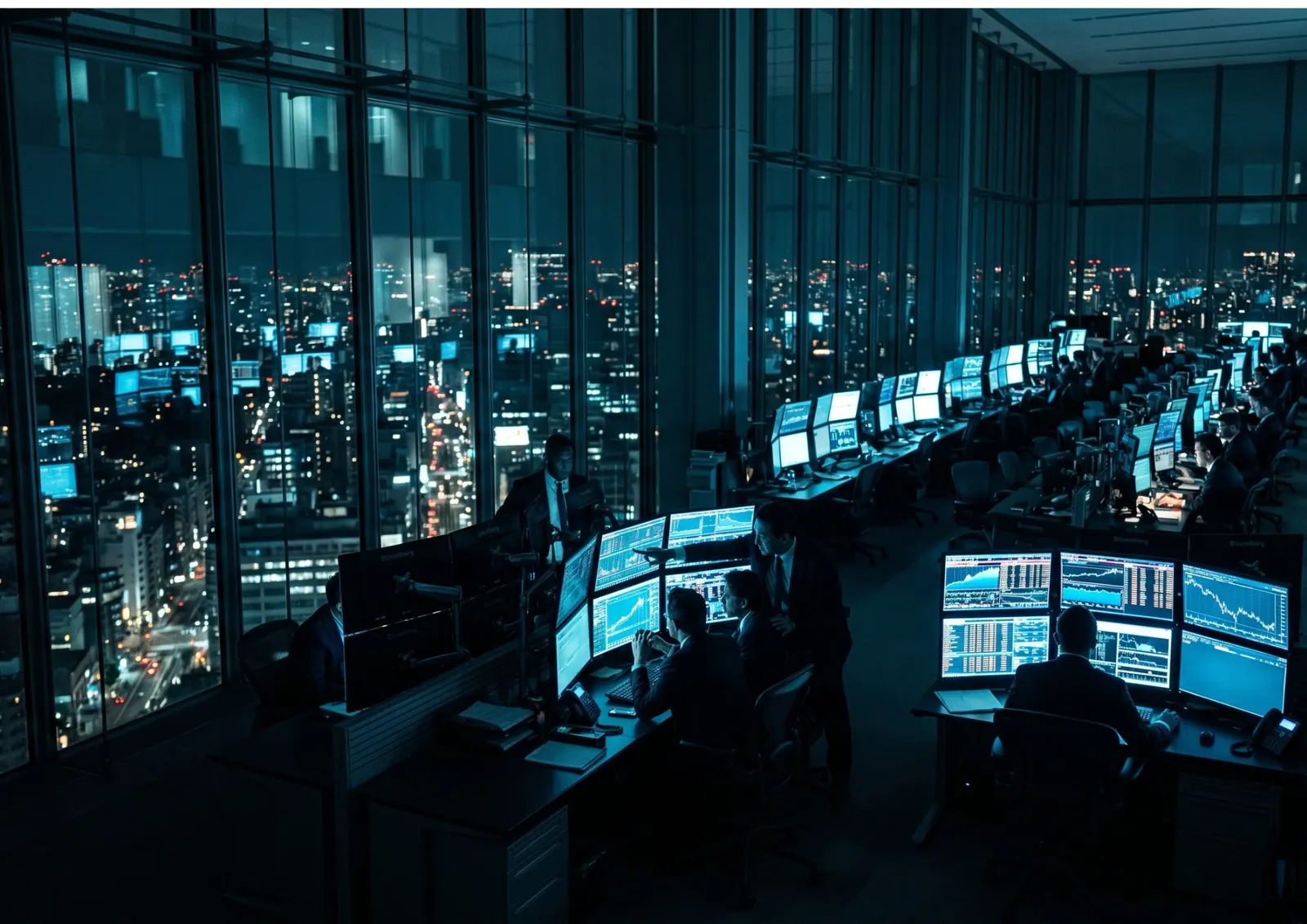
BlackRock does not open Coinbase, type in "$500 million," and hit buy. If they did, Bitcoin's price would spike 10% before the order was half filled — and they would have paid a premium to themselves.
Institutions move differently. They have entire infrastructure built around one goal: acquiring massive amounts of Bitcoin without the market knowing it's happening. Every mechanism in this article — OTC desks, dark pools, algorithmic order-splitting, ETF wrappers — exists to solve that exact problem. Understand these mechanics and you stop reading the order book as if it tells the whole story, because for the trades that actually move markets long-term, it never does.
1. Why Buying Large on a Public Exchange Is a Problem
First, understand the basic problem. Every exchange — Binance, Coinbase, Kraken — works with an order book. Think of it like a live auction board showing every pending buy and sell offer.
Imagine a fish market. The board shows: 10 fish at $5, 20 fish at $6, 15 fish at $7. If you suddenly want to buy 1,000 fish, you clean out every seller at $5, $6, and $7 — and by the time you're done, the price is $12. Everyone else watching sees the frenzy and raises their prices further. You just made fish expensive for yourself.
This is called price impact or slippage. For retail traders buying $500 worth of Bitcoin, it's negligible. For an institution buying $500 million, it can cost them tens of millions of dollars in overpayment — before they've even finished the trade.
A 2026 OTC industry report estimates that buying $10M of Bitcoin on a public exchange moves the price up by approximately 1% ($100,000 in extra cost). An OTC desk executing the same order costs roughly 0.2% ($20,000 fixed spread) — five times cheaper, with zero market impact.
2. OTC Desks — The Private Trading Room
The first solution institutions use is OTC (Over-The-Counter) trading. OTC means trading directly with another party — no public exchange, no visible order book, no price impact.
Instead of buying fish at the public market, you call a wholesale supplier directly. You agree on a price in private. The transaction happens behind closed doors. The public market never knows a massive deal just happened.
How OTC works in crypto, step by step:
-
STEP 01
The institution contacts an OTC desk — major ones include Coinbase Prime, Kraken OTC, B2C2, and Cumberland DRW. These are regulated financial institutions, not shady brokers.
-
STEP 02
They request a Streaming Quote — a live price that locks in for a short window (seconds to minutes). Example: "Buy 500 BTC at $63,200 per coin. Price valid for 30 seconds."
-
STEP 03
If the institution accepts, the deal is done instantly. The OTC desk then goes and sources the Bitcoin themselves — spreading the buy across multiple venues, gradually, without disrupting price.
-
STEP 04
Settlement happens within 24 hours. The institution receives their Bitcoin. The market never saw a spike.
3. Dark Pools — The Invisible Exchange
Dark pools are private trading venues where large block trades can execute without being visible to the public market — before or during the trade. They originated in traditional finance (stocks, bonds) and are now entering crypto.
Imagine a secret auction that happens behind a curtain. Buyers and sellers meet privately, agree on a price, and complete the trade. The public never sees the bid, the ask, or even that the auction happened — until it's already done, and the result is posted after the fact.
In May 2026, a $1.29 billion dark pool block trade crossed Nasdaq — involving BlackRock's IBIT (iShares Bitcoin Trust). Analysts only knew about it after the fact, from post-trade reporting data. The trade involved approximately 29.2 million shares at $43.16. Bitcoin's spot price barely moved during execution.
Dark pools ≠ illegal or shady. They are fully regulated. The difference is timing of disclosure: public exchanges show orders before they execute (pre-trade transparency), dark pools report only after execution (post-trade transparency). The SEC still sees everything — just not in real time.
| Feature | Public Exchange | Dark Pool |
|---|---|---|
| Order visibility | Public before execution | Hidden until after execution |
| Price impact | High for large orders | Near zero |
| Who uses it | Everyone | Institutions only (min. $250K–$1M+) |
| Regulated? | Yes | Yes — post-trade reporting required |
| Counterparty known? | Anonymous via exchange | Not disclosed at trade time |
4. TWAP and Iceberg Orders — Hiding in Plain Sight
Sometimes institutions do trade on public exchanges — but they use algorithms to make large orders look like thousands of small, unrelated orders. Two key techniques:
TWAP — Time-Weighted Average Price
TWAP splits a massive order into dozens or hundreds of tiny orders spread across hours or days. Instead of buying 1,000 BTC at once, an algorithm buys 10 BTC every 15 minutes for 25 hours.
Instead of rushing to the supermarket and clearing every shelf of rice at once (which would signal a shortage and make everyone panic-buy), you send 50 different people to 50 different stores over 3 days, each buying a small amount. Nobody notices. Shelves stay normal. Price stays normal.
Iceberg Orders
An iceberg order shows only a small visible portion of a much larger order. Example: an institution wants to buy 5,000 BTC. The exchange shows 50 BTC available. Every time that 50 BTC is filled, another 50 BTC automatically appears — until the hidden 5,000 BTC is fully accumulated. The market never sees the full size.
You cannot tell from the order book alone whether an accumulation is happening. What looks like normal buy pressure could be a TWAP algorithm executing a $100M order. This is why on-chain data and exchange flow metrics — not the order book — are the real signals.
5. ETFs as the New Accumulation Vehicle
Since January 2024, the Bitcoin spot ETF has changed everything. BlackRock's IBIT and Fidelity's FBTC gave institutions a new way to gain Bitcoin exposure without touching crypto infrastructure at all. Tracking the daily inflow and outflow of these funds — the way we break down in our ETF net flow article — has become the single most transparent public window into institutional accumulation available today.
Buying IBIT shares = buying Bitcoin indirectly. The ETF custodian (Coinbase Custody) handles actual Bitcoin acquisition using — you guessed it — OTC desks and TWAP algorithms. The institution gets clean, regulated exposure. Bitcoin accumulates invisibly in the background.
Strategy (formerly MicroStrategy) takes a different approach: it issues convertible debt and preferred stock, raises billions, then buys Bitcoin directly through Coinbase Prime — accumulating 80,000 BTC in 2026 alone. No ETF. No retail participation. Pure institutional balance sheet engineering.
6. What Institutions Do When They Want to Sell
The same mechanics apply in reverse. Institutions don't panic-sell on Binance. They use the same OTC desks and dark pools to exit positions quietly.
In Q1 2026, SEC filings revealed that Jane Street reduced its Bitcoin ETF holdings by approximately 70% and Goldman Sachs cut positions by roughly 10%. Despite these massive reductions, Bitcoin's price showed no catastrophic drop — because the selling was distributed across weeks, through private channels, at agreed prices.
SEC 13F filings (published quarterly, with a 45-day lag) reveal institutional Bitcoin ETF positions after the fact. Following these filings closely tells you what the smart money was doing in the previous quarter — a lagging but highly reliable signal of institutional conviction.
7. How to Read These Signals as a Trader
You cannot see OTC trades in real time. You cannot see dark pool orders in advance. But you can track the effects of institutional accumulation through public data:
-
SIGNAL 01
ETF Net Flow Data — Published daily. Consistent inflows into IBIT and FBTC signal institutional accumulation. Eight-day streaks of inflows following corrections are historically strong buy signals.
-
SIGNAL 02
Exchange Outflow — When large amounts of Bitcoin move off exchanges into cold wallets, it signals institutions are accumulating and removing supply from circulation. Price follows reduced supply. See our full breakdown of reading exchange flow data for how to track this yourself.
-
SIGNAL 03
OTC Desk Premium/Discount — When OTC prices trade at a premium to spot, it signals more institutional buyers than sellers. When at a discount, the reverse. Some on-chain analytics platforms track this.
-
SIGNAL 04
SEC 13F Filings — Every quarter, US institutional managers must disclose their holdings. Following which firms increased or decreased Bitcoin ETF exposure reveals who is accumulating at scale.
-
SIGNAL 05
Stablecoin Supply on Exchanges — Rising USDT/USDC sitting on exchanges means institutional buying power is staging. When that supply deploys into Bitcoin, price moves. We cover this signal in depth here — watch it before large moves.
📌 Key Takeaways
- Institutions never buy on retail exchanges at market price. They use OTC desks, dark pools, TWAP algorithms, and iceberg orders to accumulate without price impact.
- The $1.29B BlackRock dark pool trade in May 2026 is the clearest recent example: $1.3 billion moved, price barely flinched.
- ETF flows are now the cleanest public signal of institutional Bitcoin demand. Daily net flow data from IBIT, FBTC, and others is freely available and should be tracked.
- What you see on the order book is not the full picture. The largest positions are built and unwound in channels you cannot see in real time — only through lagging on-chain and regulatory data.
- Smart Money Concepts (SMC) in trading — including Order Blocks and the full SMC framework — are direct observations of institutional footprints left on the chart by exactly these accumulation behaviors.